
Signed checks
An agent saying “done” is a claim. With
require_evidence, the agent that
wrote the fix also writes the proof. With signed checks, the daemon runs
the checks itself and signs what it saw:
Done is a claim. A signed run on the same tree is proof.
Configure
Section titled “Configure”Add a verify list to a profile:
agent: profiles: implementer: require_evidence: [test] verify: - name: test run: make test - name: lint run: golangci-lint run timeout_ms: 300000| Key | Required | Meaning |
|---|---|---|
name | yes | A short name: lower-case letters, digits, - or _ (test, lint). Unique in the list. ci is reserved for the pull request’s CI checks. |
run | yes | The command line, run by bash with pipefail in the worktree. |
timeout_ms | no | Kill the check’s process group after this long. Default 600000 (10 minutes). |
An unknown key, a bad name or an empty run is a config error, never
dropped. A check silently ignored would let unverified work through. See the
verify reference.
What happens after the agent’s run
Section titled “What happens after the agent’s run”After the agent’s last turn, before the run counts as succeeded, the worker:
- runs each check in order, in the worktree, on the files as the agent left them (committed or not), and stops at the first failure;
- records each check and seals the run with the tree after the last one;
- signs every record and appends it to the run’s record file.
This happens after hooks.after_run_required and before every success side
effect: the handoff, the pull request push and the completion move. Under
isolation: process the checks run inside the agent’s
sandbox, so the code under test cannot read the signing key.
The agent’s prompt names the checks Itervox will run, so it does not spend turns recording them.
When a check fails, the run is held
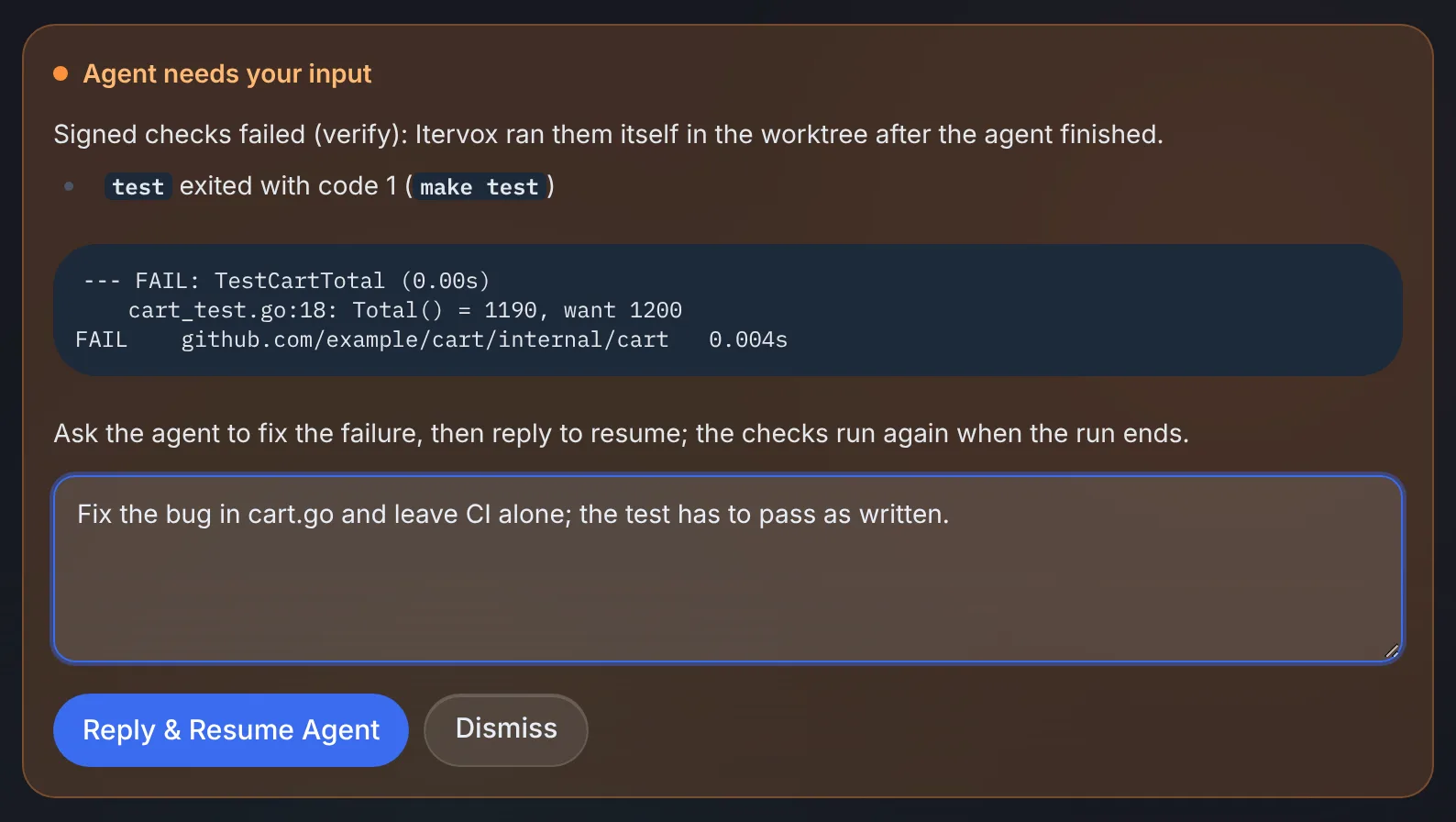
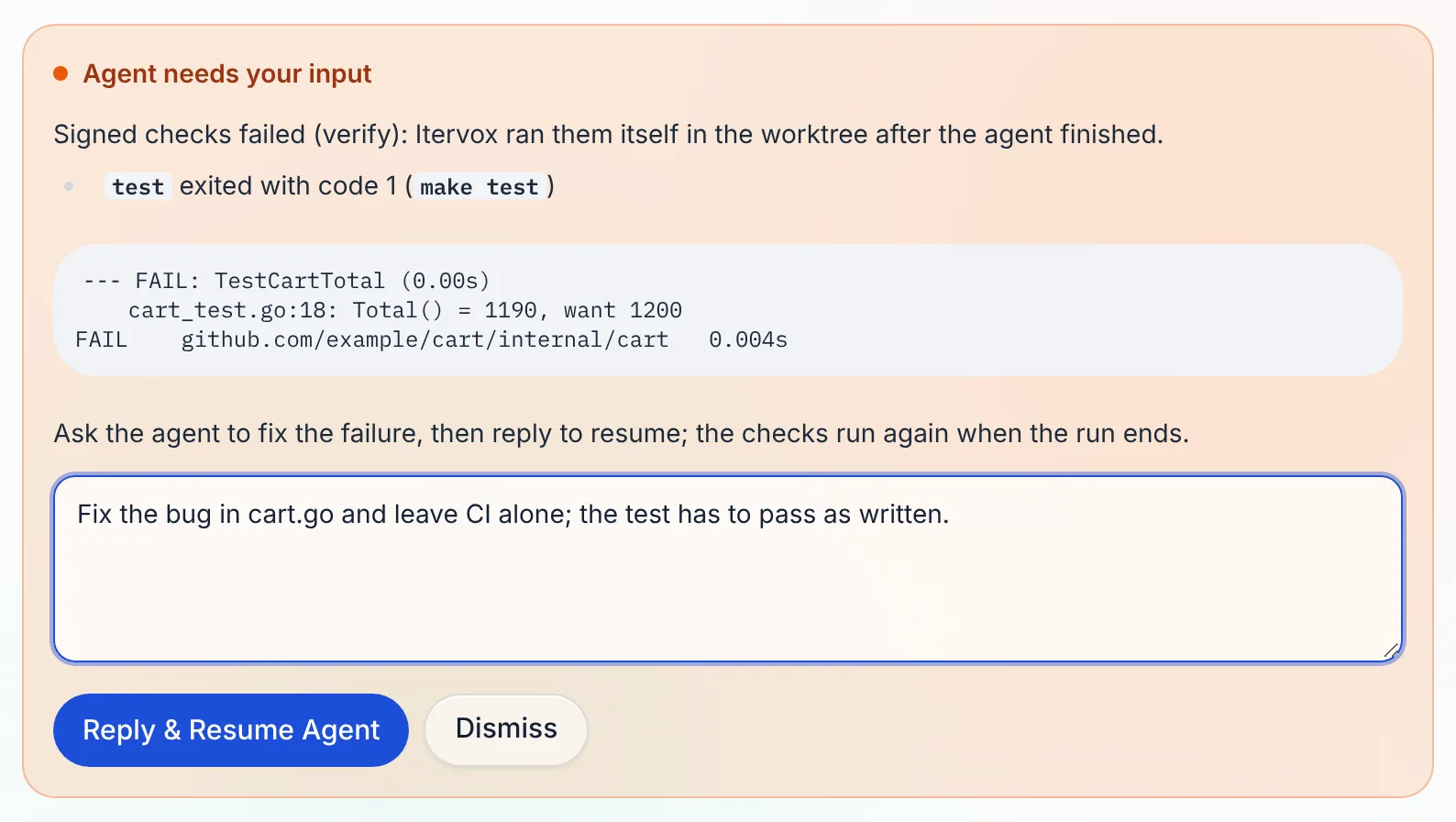
Section titled “When a check fails, the run is held”A check fails when it exits non-zero, times out, cannot start, or changes the working tree (its tree differs from the seal). The run is then held input required instead of moving on, with the check’s name, exit code, command and the last lines of its output:
Signed checks failed (verify): Itervox ran them itself in the worktree after the agent finished.- `test` exited with code 1 (`make test`)Reply to resume the agent, for example “fix the bug in cart.go, leave the
test as it is”. The checks run again when that run ends. Every check exiting
0 lets the run succeed.
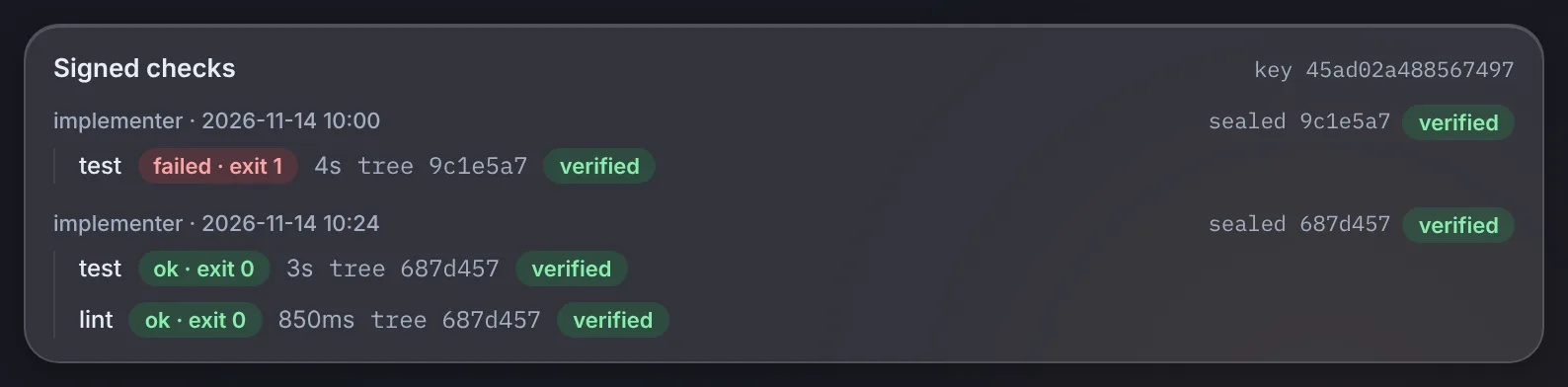
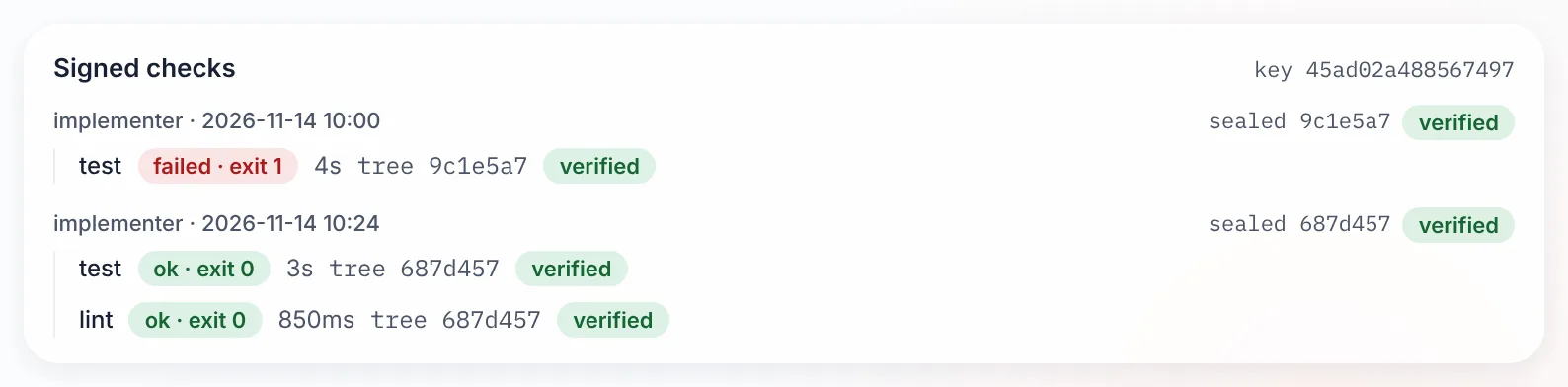
A failing check, a reply, a passing run


The evidence gate
Section titled “The evidence gate”verify and require_evidence share one gate:
- a
require_evidencename that is also averifyname is proven by the daemon’s signed run only. The agent’s own evidence file is not read for it, so the writer is never the judge; - other
require_evidencenames still need the agent’s evidence file, andcistill needs the pull request’s checks; itervox doctorlistsrequire_evidencenames that noverifycheck runs as agent-reported, not daemon-run.
What a record contains
Section titled “What a record contains”One JSON line per check in
.itervox/attestations/<identifier>/<run timestamp>_<profile>.jsonl next to
WORKFLOW.md, then a seal line with the tree after the last check.
| Field | Meaning |
|---|---|
command, argv, pipefail | The configured command (redacted) and how it ran. With pipefail, make test | tail records make’s status, not tail’s. |
exit_code, timed_out, error | The real exit status; -1 when the check was killed or could not start. |
started_at, duration_ms | When it ran and for how long. |
output_sha256, output_tail | SHA-256 of the complete stdout and stderr; their last 4 KiB, redacted like log lines. |
tree_hash, tree_excludes, head | The git tree of the working tree when the check started (tracked plus untracked, non-ignored files, without .itervox/handoff/ and .itervox/evidence/) and the HEAD commit. |
key_id, sig | The signing key’s id and an ed25519 signature over every other field. |
The tree hash is computed through a private index (GIT_INDEX_FILE in a
temporary directory), so your index, staged changes and git status are
untouched.
The signing key
Section titled “The signing key”The daemon (and itervox run) creates an ed25519 key pair the first time it
starts with a profile that has verify:
| File | |
|---|---|
.itervox/attest.key | The private key, mode 0600. Gitignored, and on the isolation deny list. |
.itervox/attest.pub | The public key. Share it so others can verify records. |
A project without verify gets no key files. If the key cannot be loaded,
the checks still run and still gate the run, but their records are neither
signed nor stored, and the daemon logs a warning.
Verify the records
Section titled “Verify the records”The dashboard API lists an issue’s records with verified and a reason
(GET /api/v1/issues/{identifier}/attestations,
viewer scope), and the issue panel’s Signed checks section shows the
same result. A record that does not verify is marked not verified with
the reason:
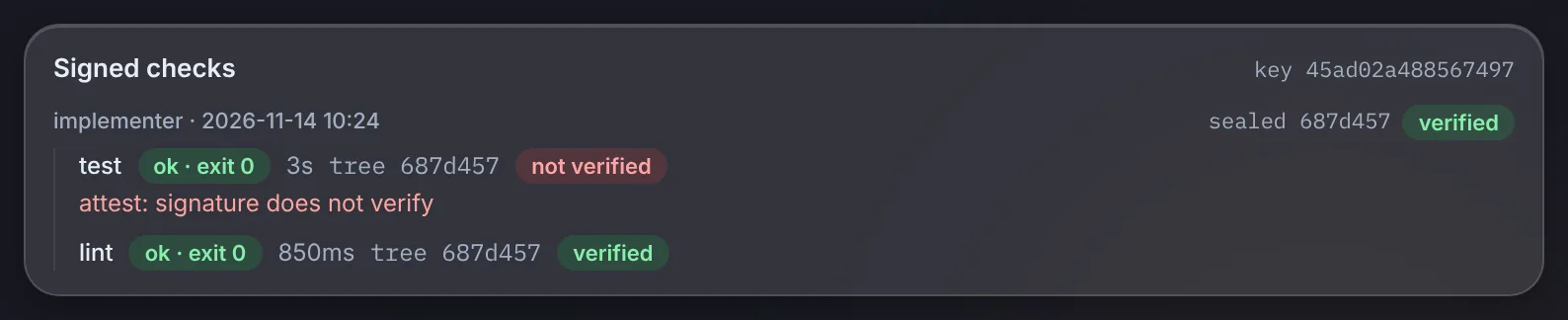
Offline, anyone with the public key can check a file:
itervox attest verify .itervox/attestations/ENG-1/2026-11-14T10-00-00.000Z_implementer.jsonl --tree ../worktree ok check test exit=0 tree=687d457a30e7 head=7b08300e2e83 ok seal tree=687d457a30e7 head=7b08300e2e83 all 2 records verify (key 45ad02a488567497)- Every signature must be valid for the public key:
--pubkey PATH, or by default.itervox/attest.pubnext to--workflow. - Every check must have run on the run’s final tree (the seal’s).
--tree DIRalso requires that tree to beDIR’s working tree now, so the records are for the code in front of you. A record from an earlier tree fails it.
An edited exit code or output hash fails the signature. Exit 0 when every
record verifies, 1 when one does not, 2 on a usage or read error. See the
CLI reference.
Signed checks in CI: itervox referee
Section titled “Signed checks in CI: itervox referee”itervox referee (or the standalone referee binary) signs CI check runs in
the same record format, for any agent and any CI:
itervox referee keygen --out "$RUNNER_TEMP/keys" # attest.key (0600) + attest.pubitervox referee run --name test --key "$RUNNER_TEMP/keys/attest.key" --out checks.jsonl -- 'go test ./...'itervox referee verify checks.jsonl --pubkey "$RUNNER_TEMP/keys/attest.pub" --tree .runappends a check record and a seal, and exits with the check’s own exit code (1when it was killed, timed out or did not start;2when it cannot sign or write). It refuses a key inside the working tree.verifyexits0when every record verifies,1when one does not,2on an error. The records have the same format as the daemon’s.
Keep the private key in a CI secret available only to the job that runs the checks, not to the job the agent runs in. See referee.
Patches only
Section titled “Patches only”With push: daemon, the
daemon pushes the agent’s commit itself after the gates. With verify, only
the tree the signed checks ran on is pushed.
What it does not prove
Section titled “What it does not prove”A signature says this daemon ran this command on this tree and saw this exit code. It does not say the command tests the right thing.
- Keep
verifycommands inWORKFLOW.md, not in files the agent edits.make testruns theMakefileon the agent’s branch, so keep theMakefilein the human lane (it is by default).itervox doctorwarns about a check whose definition is outside it. - Without
isolation: processan agent runs as your user and could read the key. The signature then proves only that the record was not edited afterwards.