
Memory
Itervox forgets everything between runs except the handoff files. Memory fixes the most common case: you correct an agent once (“this repo uses pnpm, not npm”) and every later run is told, without you repeating it.
An entry is a short piece of text with a type:
| Type | Example |
|---|---|
| Preference | ”Keep my PR descriptions under 10 lines.” |
| Fact | ”The staging DB is read-only on Fridays.” |
| Decision | ”We chose Tauri over Electron for the Mac app.” |
| Lesson | ”pnpm test flakes on the SSE test; rerun once before failing.” |
Entries live in two files: private (~/.itervox/memory.json, only you, never committed) and project shared (.itervox/memory.json, committed with the code, so every run on the repository uses it). The file format, the size caps and the selection rules are in the configuration reference; the budget settings are under memory.
How a run uses memory
Section titled “How a run uses memory”At every dispatch the daemon reads both files again (no restart after an edit) and builds the run’s ## Memory block:
- Only
activeentries whoseprofilesmatch the run are considered. Proposed lessons and archived entries are never used. - Pinned entries are always included.
- The rest are ranked by how many of their words and tags also appear in the issue’s title, description and labels and the profile name, and added best first while they fit
memory.token_budget(default 2000 tokens). Rules and memory together stay withinmemory.prompt_share_tokens(default 8000): memory gets what the rules leave, so the lowest-ranked memories are dropped first and rules never are.
The prompt is assembled as: the WORKFLOW.md template and the daemon’s blocks (reply envelope, handoffs, run context), then the profile tail — rules → memory → SOUL.md → INSTRUCTIONS.md → playbook — and the automation instructions and sub-agent roster after them.
Each finished run lists the memory it was given (memoryIds in run history), and the memory is part of its prompt version. Once the block reaches the agent, each entry’s last used time and use count are updated.
The Memory page
Section titled “The Memory page”Open Memory in the sidebar (after Repo Analysis), with g m, from the command palette, or from the Mac app’s per-daemon menu.
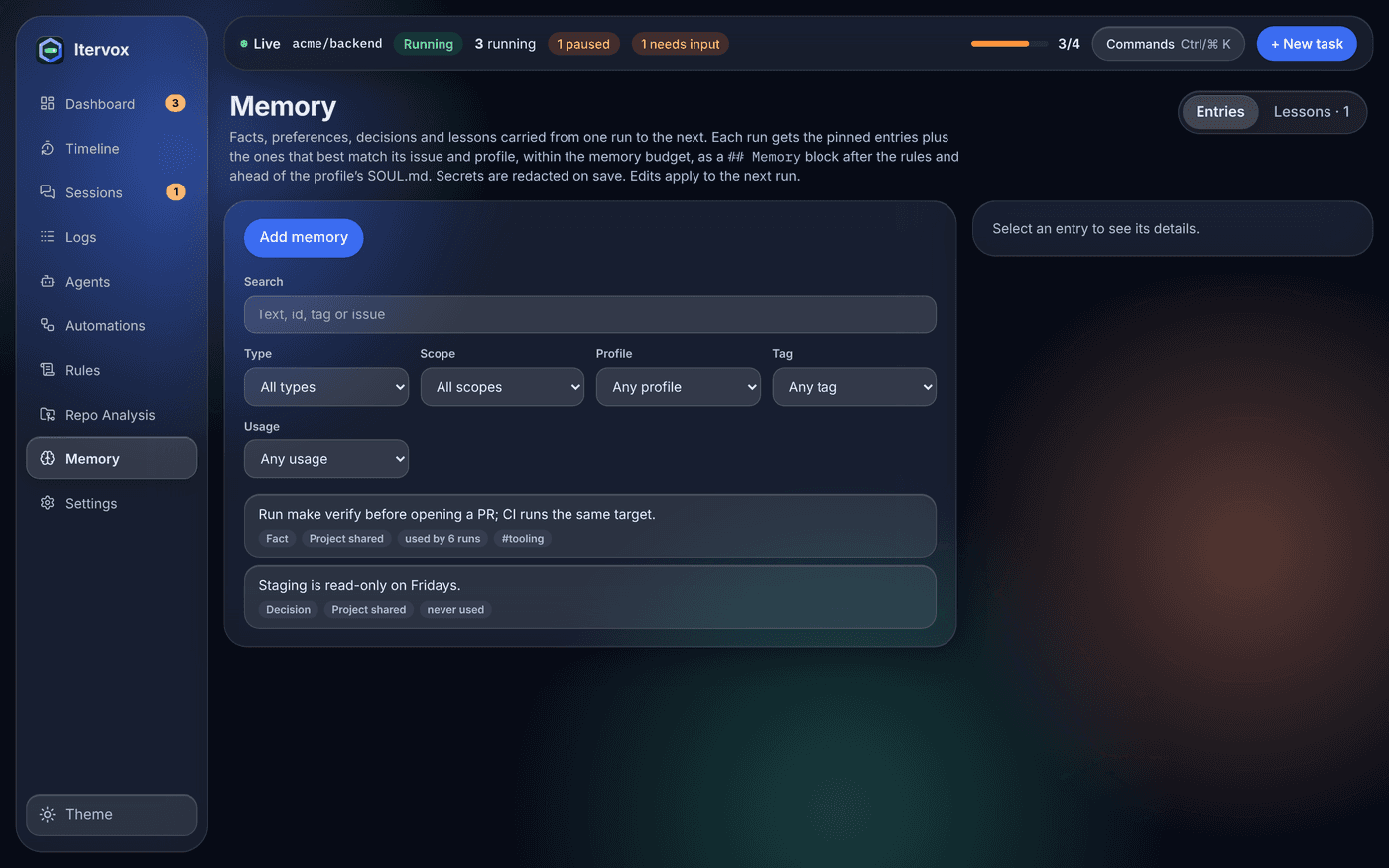
- Add memory: write the text, pick a type, private or project scope, and tags. Text over 2000 bytes is refused. Secrets (tokens, keys, passwords) are redacted before the entry is saved.
- Search and filter by text, type, scope, profile, tag and usage (used by a run / never used).
- Select an entry to see its full text, provenance (where it came from: issue, runs, PR or comment links), when it was created, updated and last used, how many runs used it, and the most recent runs whose prompt carried it.
- Edit the text, type, tags and profiles inline. Pin an entry so every run gets it. Archive keeps an entry without using it. Delete removes it; Undo in the banner puts it back exactly as it was.
- Share with the project moves a private entry into
.itervox/memory.jsonand shows the file’s git diff (or the whole file while it is not committed yet). Commit it to share it with the team. - Open in editor: the dashboard cannot launch your editor, so it shows the file’s path with a copy button; open it in your editor, where the
$schemagives completion. The daemon rewrites the files to record usage, so comments are not kept.
The Lessons tab is the review queue for the lessons Itervox proposes (below), with a count on the tab and on the Memory item in the sidebar.
Lessons
Section titled “Lessons”Most of what is worth remembering comes out of corrections and failures, and nobody writes memories by hand after every run. So Itervox proposes lessons itself, and a human approves them. A proposed lesson is a lesson entry with status: proposed: no run uses it until it is approved.
Itervox proposes a lesson when:
- A human corrected an agent: a reply to an input-required question (from the dashboard or a tracker comment) or a steering message from the Sessions panel that tells the agent to do something differently (“don’t add a dependency, use the csv helper instead”). Replies that only answer or agree (“yes, go ahead”, “port 8080”) propose nothing.
- A failed run was followed by a success: a worker run on an issue failed or stalled and a later run on the same issue succeeded. The lesson records what changed in between: the steering messages and input replies since the failure, and blocking reviewer feedback. A retry that simply worked the second time, with nothing changed, proposes nothing.
- Reviewers asked for the same kind of change twice: a reviewer’s blocking verdict asks for a change (its reasons and line comments) that a reviewer already asked for on another run or issue, by the same normalized-word similarity that deduplicates lessons. The daemon’s own verdict notes (“no parseable verdict recorded”, “reviewer changed the branch”) never count.
- A merged agent PR was reverted: every 30 minutes, off the event loop, the daemon scans the base branch for reverts the same way Repo Analysis hotspots do (
Revert "… (#N)"subjects,revert-N-…branches, “This reverts commit …” bodies, read-only through git) and proposes a lesson on the issue of the agent run that opened the reverted PR, naming the PR and the revert. - A hard-won success (a recipe): a worker run succeeded after at least
recipe_min_failed_runsfailed attempts (default 2), after a steering message, or after at leastrecipe_min_turnsturns (default 40), and no failed-then-succeeded lesson already explains it. The recipe is what worked and the verification that proved it, read from the run’s handoff (its “What changed” / “Summary” and “Verification” / “Tests” sections), else the steering messages. It is drafted as “Recipe: when situation, what worked. Verify with: the check.”
Drafting. The daemon notices these on its event loop, but the wording is drafted off it: one short call to the backend of the lesson profile (memory.lessons.profile, by default the reviewer profile) with the evidence attached, no tools, an empty temporary directory and a hard budget (draft_token_budget, draft_timeout_ms). With no profile, or when the call fails or runs over budget, the lesson is filled in from a template: “When situation, what worked. Instead of: what went wrong.” Secrets are redacted before anything is saved.
One lesson, not ten. A proposal that is a near-duplicate of an existing proposed or approved lesson (by normalized-word similarity of its text, or of the correction it came from) does not add a second entry: it bumps the existing lesson’s evidence (its runs and links, the “seen” count and its confidence) and skips the drafting call. Each issue proposes at most memory.lessons.max_per_issue lessons (default 3) per rate_window_hours (default 24).
Reviewing. Each proposal in the Lessons tab shows what triggered it, the situation, what went wrong and what worked, the issue, the runs and links it came from, how confident Itervox is and how often it was seen. Then:
- Approve into Private or Project shared (moving it between the files when needed). From then on runs use it like any other entry.
- Edit, then Save and approve, to fix the wording first.
- Reject removes it and remembers it, so the same lesson, or a near-duplicate of it, is not proposed again. Rejections are kept in
.itervox/lessons-rejected.json(only the normalized words and a fingerprint, never the text; gitignored with the other runtime files under.itervox/).
memory.lessons.auto_approve (default false, per scope) approves proposals as they land.
A sighting whose runs are all already part of a lesson’s evidence (the same revert scanned again after a restart, say) does not raise its count.
Approved lessons. The Approved view lists the approved lessons with their analytics: how many runs had the lesson in their prompt, and the runs in history that used it with how they ended (succeeded, failed). From there you can promote a lesson to a rule: choose the Project (.itervox/rules.json, committed) or User (~/.itervox/rules.json) layer and a severity, and the lesson becomes rule lesson-<entry id>, scoped to the lesson’s profiles, with a description naming the lesson. The lesson is archived with a pointer to the rule (lesson.rule), so runs get it as a rule from then on. Promoting writes a rules layer, so it needs an admin token, like the Rules editor.
Enforcement suggestions. A lesson that keeps coming back should be enforced, not just remembered. Once a lesson has been seen memory.lessons.enforce_threshold times (default 3), the drafting call that bumped it also drafts the strongest enforcement it can, preferring in order a lint rule, a type, a test, a CLAUDE.md or AGENTS.md rule, and only then an Itervox rule (template fallback: an Itervox rule with that ladder spelled out). The suggestion appears on the lesson’s card. Create Enforce issue creates an “Enforce: lesson” issue in the tracker (in enforce_issue_state, by default the first backlog state) carrying the draft and the evidence, so an agent implements it like any other issue: Itervox never writes or commits the code itself. Dismiss turns it down for good.
Not helping. The Not helping filter lists approved lessons that none of the last memory.lessons.stale_after_runs runs (default 20) used, lessons whose recent runs mostly failed, and lessons now enforced by an accepted enforcement issue (archive them once it lands), so you can edit or archive them in Entries.
Git and remote daemons
Section titled “Git and remote daemons”itervox init, itervox init --update and the daemon’s startup add the carve-outs that keep .itervox/memory.json committable when .itervox/ is otherwise ignored, and itervox doctor’s repo readiness warns when a root .gitignore hides it. On a remote daemon, private memory is the daemon user’s ~/.itervox/memory.json (set ITERVOX_USER_MEMORY to move it, off to disable it).
GET /api/v1/memory, POST /api/v1/memory, PUT and DELETE /api/v1/memory/{id}, POST /api/v1/memory/{id}/pin, POST /api/v1/memory/{id}/promote, and for lessons POST /api/v1/memory/{id}/approve, POST /api/v1/memory/{id}/reject, POST /api/v1/memory/{id}/promote-to-rule and POST /api/v1/memory/{id}/enforcement/accept / dismiss, and GET /api/v1/memory/recall (search ranked like run-time retrieval, used by itervox mcp); see the API reference.