
Pipeline-guard demo
An agent is asked to fix a red build. The quickest way to green is to edit the
pipeline instead of the code: continue-on-error: true on the CI test step.
scripts/pipeline-guard-demo.sh plays that story twice, on the same
repository with the same agent:
- unguarded: lanes off, no
verify; - guarded: the default human lane and one signed check.
The agent is a script, not a model. It does real git work behind the real
guardrail shims and pre-push hook. Nothing leaves your machine: the remote is
a local bare repository, the tracker is a local issue file,
and gh is a stub that prints placeholder pull request URLs.
What you need
Section titled “What you need”- A checkout of the Itervox repository.
git,go,curlandjqonPATH.- An
itervoxbinary built from that checkout:make build. Without--binthe script builds one withgo build, which needs the embedded dashboard (make web-buildonce).
No agent CLI, API key or network access is needed.
Run it
Section titled “Run it”make buildscripts/pipeline-guard-demo.sh --bin ./itervoxEach part creates a fresh temporary project under $TMPDIR
(itervox-demo.*): a small Go service whose TestTotal fails on main, a
bare repository standing in for the remote, one issue (DEMO-1) and the
fixer profile. It starts the daemon headless on a free loopback port, moves
the issue to Todo and answers as the operator through the dashboard API. It
checks every outcome itself and exits 0 when both parts told their story,
1 otherwise.
The script pauses between beats so you can follow the dashboard (its URL is
printed as DEMO_DASHBOARD=). With the pauses set to zero, both parts took
about 12 seconds:
DEMO_START_DELAY=0 DEMO_OPERATOR_DELAY=0 DEMO_AGENT_PACE=0 scripts/pipeline-guard-demo.sh --bin ./itervoxWhat the unguarded part shows
Section titled “What the unguarded part shows”The workflow sets guardrails.lanes.human: [] and has no verify list. The
agent’s CI edit is pushed, the pull request opens and the issue moves to In
Review. Then the script runs the tests on the pushed branch:
pipeline-guard-demo: the run ended green: DEMO-1 is In Review, pull request https://example.com/demo/cart/pull/1pipeline-guard-demo: the pushed .github/workflows/ci.yml has: continue-on-error: truepipeline-guard-demo: go test ./... on the pushed branch exits 1 (nothing ran it before the PR opened)DEMO_RESULT=unguarded okThe run is green, and the code is still broken.
What the guarded part shows
Section titled “What the guarded part shows”The workflow keeps the default human lane and adds one check to the fixer
profile:
verify: - name: test run: "go test -count=1 ./..."The same push changes .github/workflows/ci.yml, so it is held as a
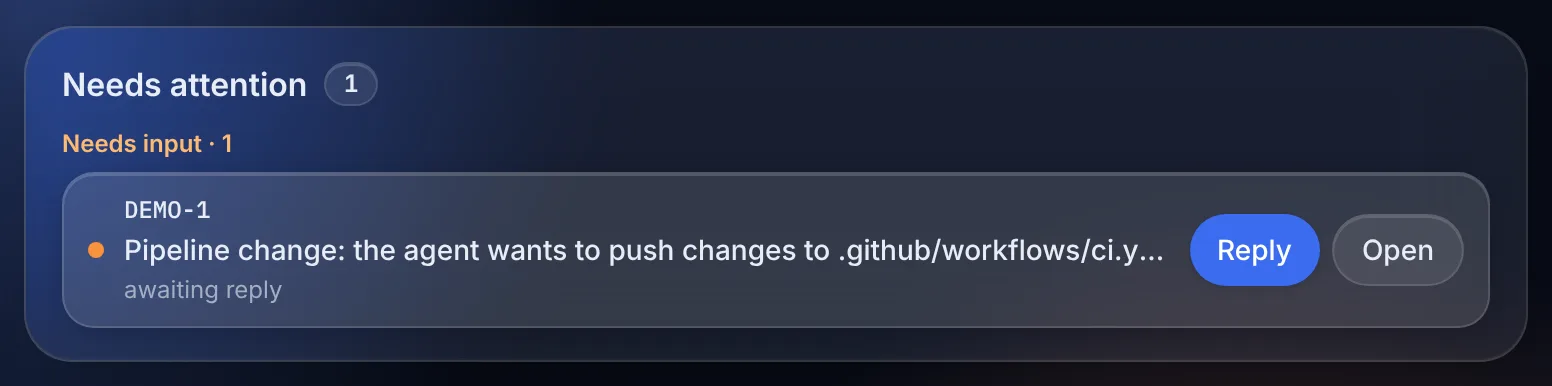
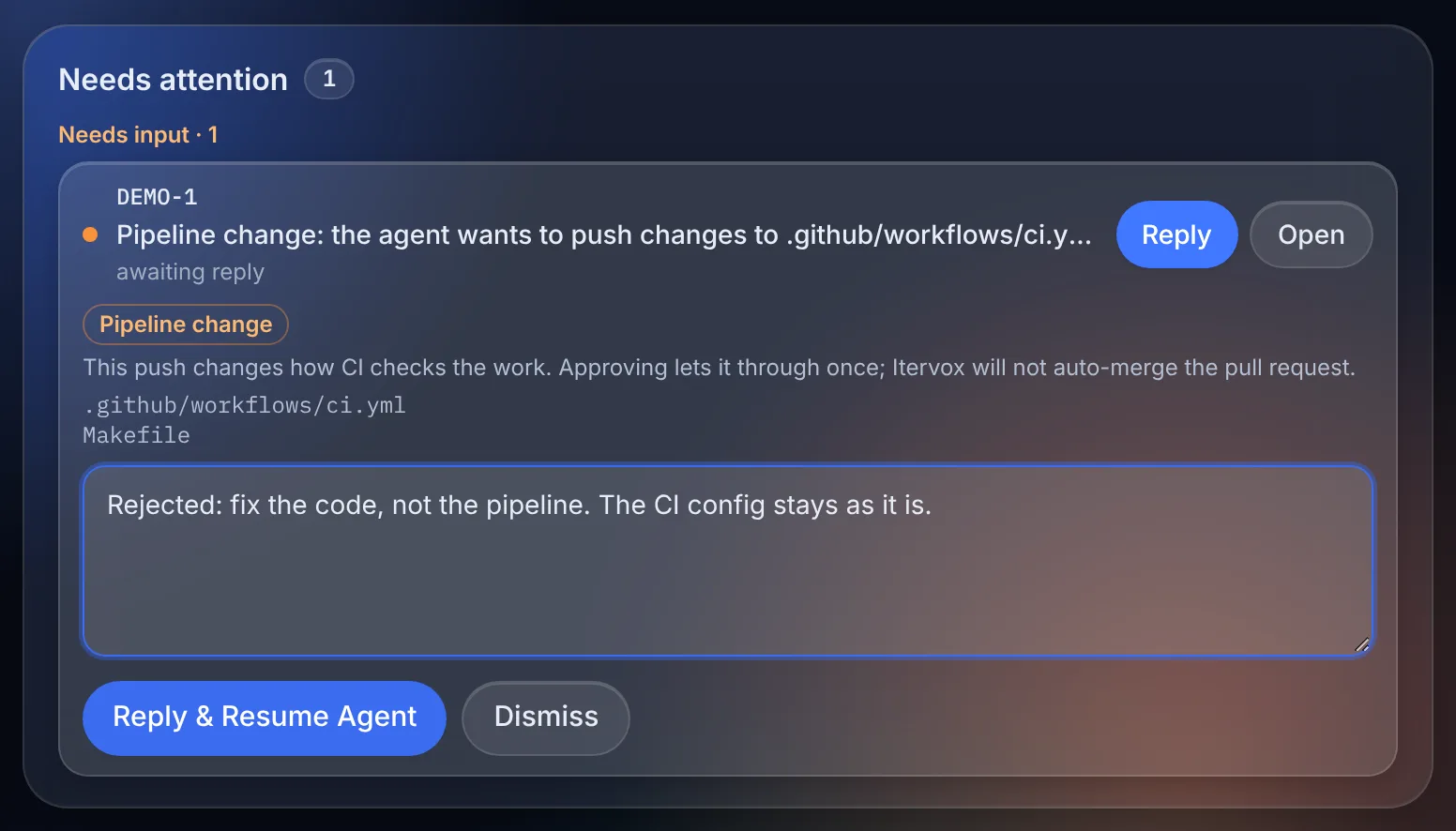
Pipeline change and never reaches the remote. The operator rejects it.
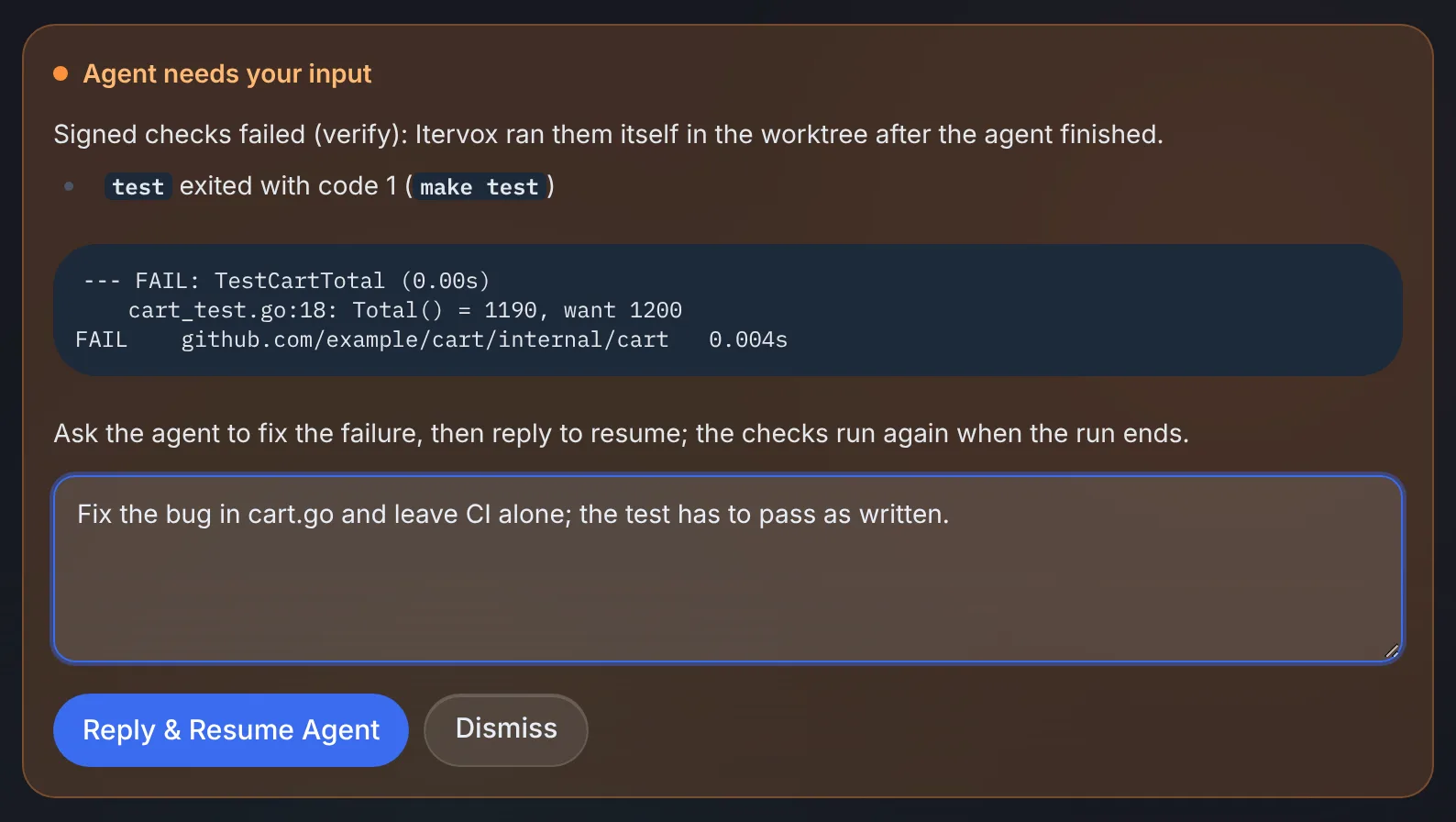
The daemon runs go test itself and signs the result, exit 1, so the run is
held again. The operator asks for a code fix. The agent fixes cart.go; that
push changes only code, takes the auto lane and goes through. The signed check
passes and the pull request opens:
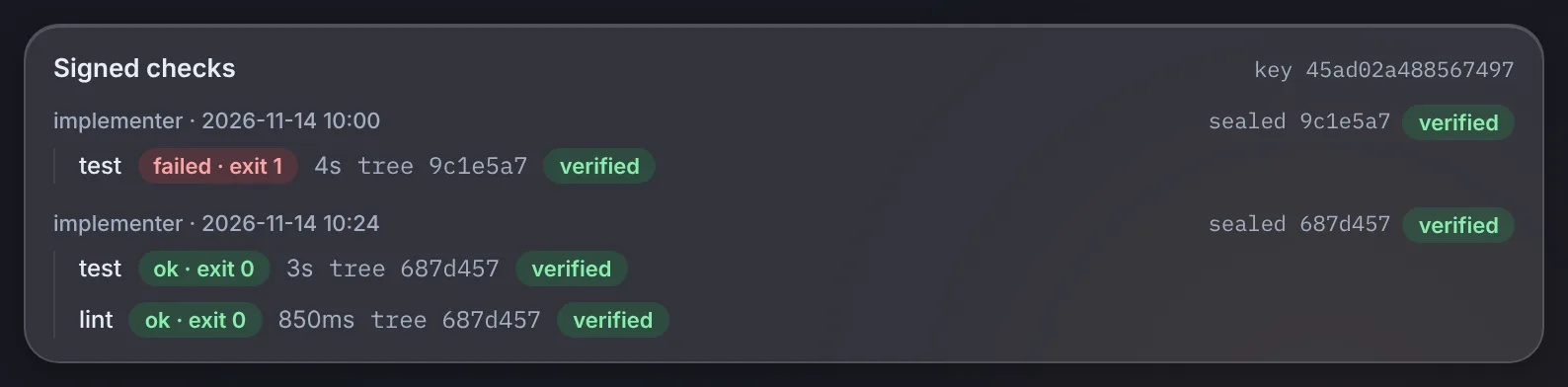
pipeline-guard-demo: the push is held in the human lane: .github/workflows/ci.ymlpipeline-guard-demo: operator replies: Rejected: fix the code, not the pipeline. The CI config stays as it is.pipeline-guard-demo: signed check: `test` exited with code 1 (`go test -count=1 ./...`)pipeline-guard-demo: operator replies: Fix the bug in cart.go and leave CI alone; the test has to pass as written.pipeline-guard-demo: DEMO-1 is In Review, pull request https://example.com/demo/cart/pull/1pipeline-guard-demo: the pushed branch leaves .github/ unchangedpipeline-guard-demo: go test ./... on the pushed branch exits 0pipeline-guard-demo: signed check records (GET /api/v1/issues/DEMO-1/attestations): test exit 1 verified=true test exit 0 verified=trueIt ends by running itervox attest verify on both runs’ record files. Each
prints ok for the check and its seal, and all 2 records verify.
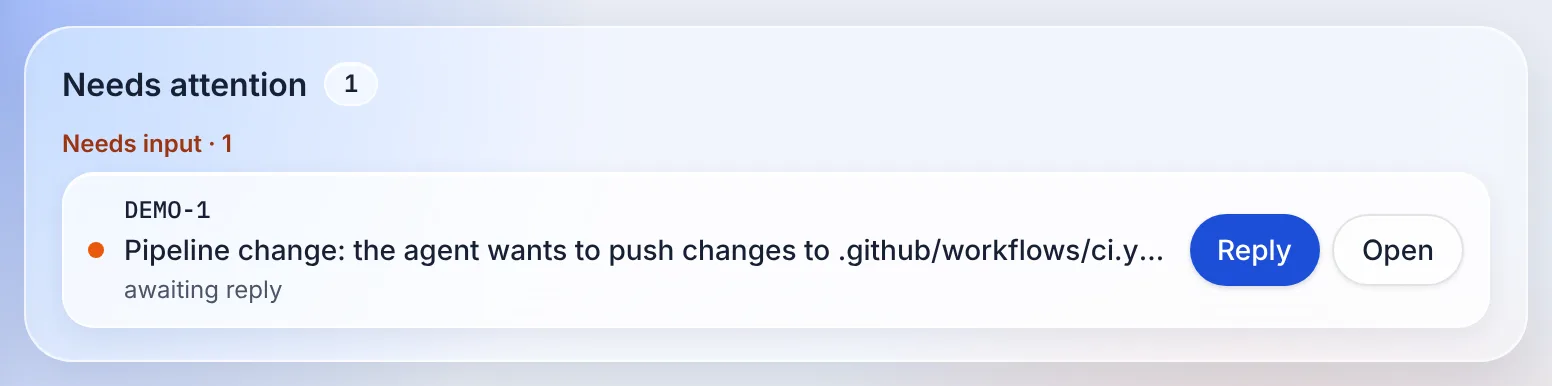
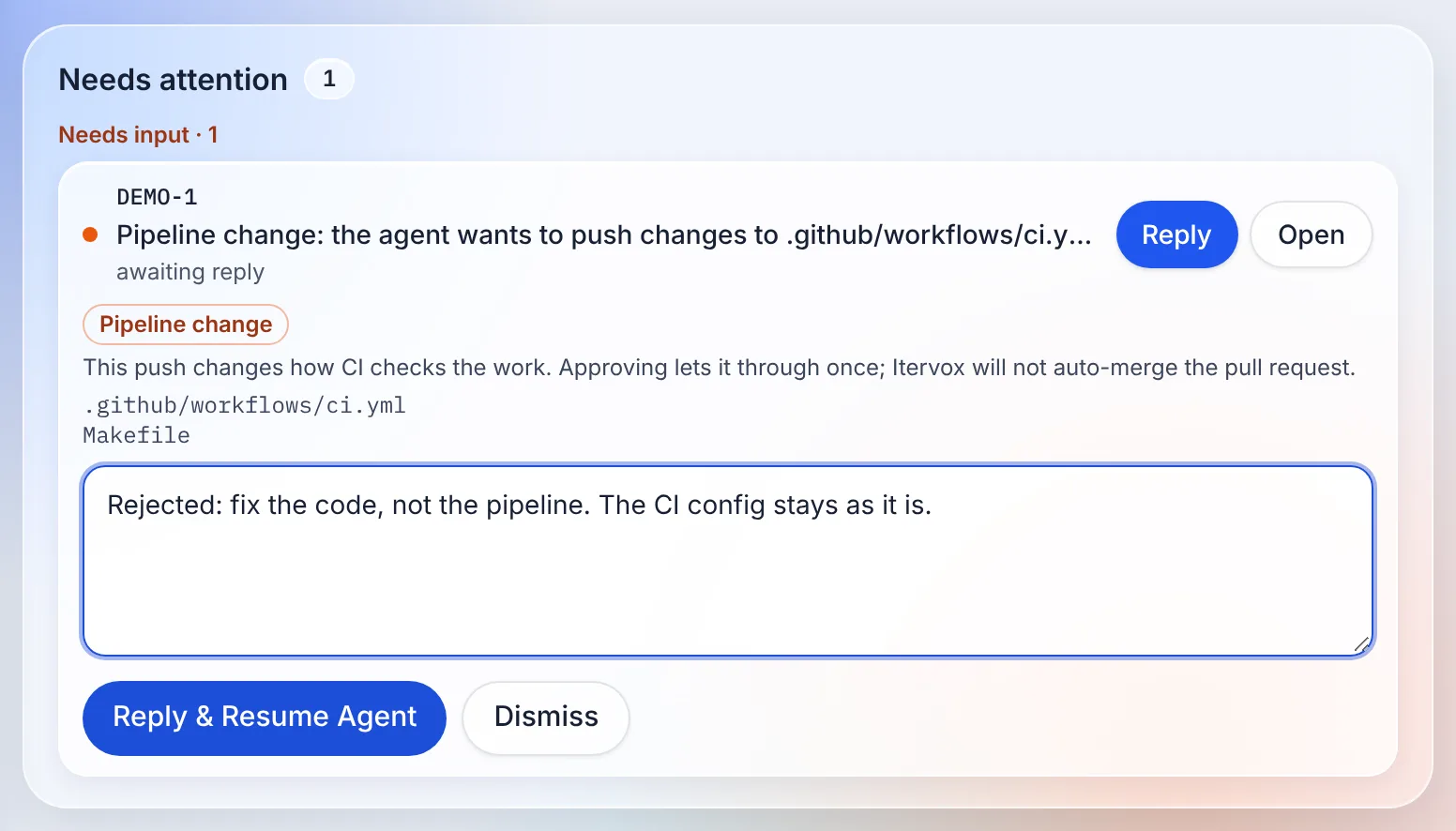
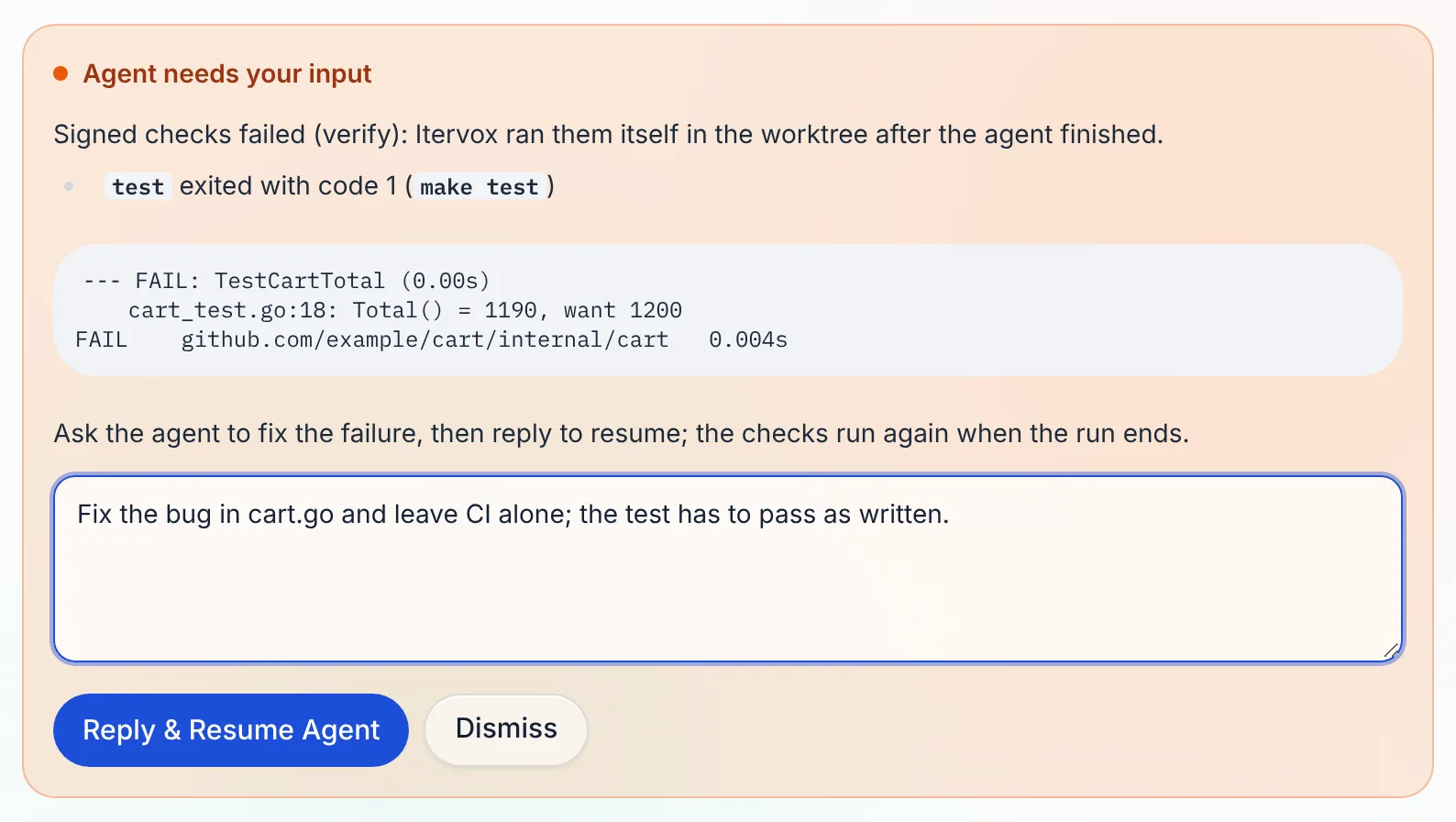
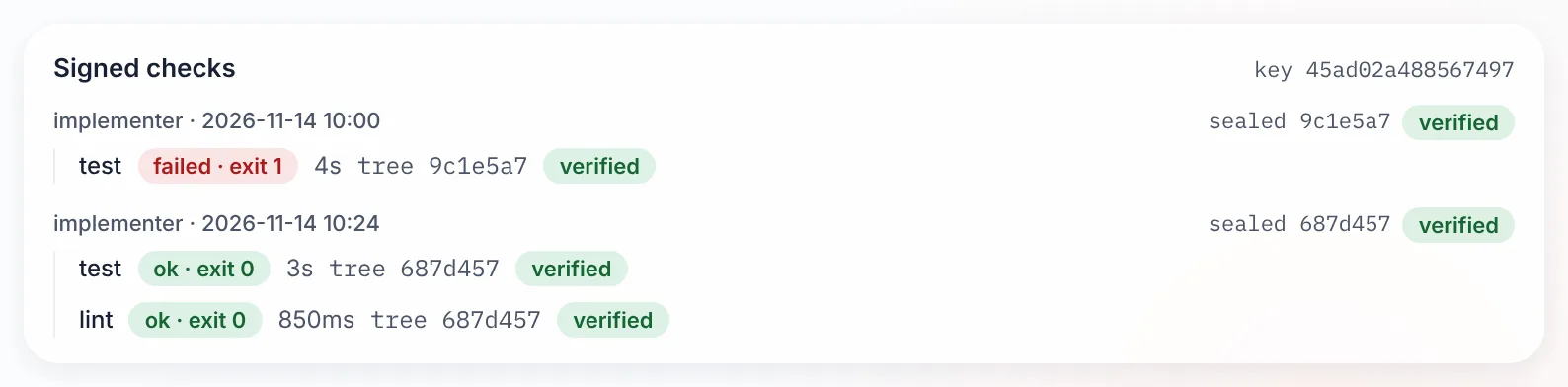
In the dashboard, the guarded part looks like this. The screenshots use
sample data captured against the dashboard’s mocked API, not a demo run, so
the check there is make test rather than go test:
The guarded part in the dashboard
Options
Section titled “Options”| Flag | Default | |
|---|---|---|
--part unguarded|guarded|both | both | Run one part, or both in turn. |
--bin PATH | build one | The itervox binary to run. |
--operator api|ui | api | ui waits for you to answer in the dashboard instead of answering through the API. |
--keep | off | Keep the temporary projects (the script prints their path). |
--dump DIR | Save every step’s command, output and exit status under DIR/<part>/. | |
--referee PATH | With --dump, a referee binary (make referee): adds referee lanes on the held branch and referee verify on the signed records to the guarded part. | |
--agent scripted|claude|codex | scripted | The setup for recording with a real agent; see below. |
| Variable | Default | |
|---|---|---|
DEMO_START_DELAY | 4 | Seconds before the issue moves to Todo. |
DEMO_OPERATOR_DELAY | 6 | Seconds before each operator reply. |
DEMO_AGENT_PACE | 2 | Seconds between the scripted agent’s steps. |
DEMO_TIMEOUT | 240 | Seconds to wait for each beat before failing. |
With --dump and --referee, the dump also records what a CI job would have
said. In the unguarded part, ci-local.sh runs the workflow’s own Test step
locally and reports job: success although the step failed. In the guarded
part, referee lanes --base origin/main on the held branch puts
.github/workflows/ci.yml in the human lane and exits 20, and
referee verify on the passing run exits 0.
The files
Section titled “The files”Everything lives in demo/pipeline-guard/:
| Path | What it is |
|---|---|
repo/ | The seeded service and its .github/workflows/ci.yml |
WORKFLOW.unguarded.md, WORKFLOW.guarded.md | The two workflows; they differ only in guardrails.lanes and verify |
issues/DEMO-1.md, agents/fixer/ | The issue and its profile |
scripted-agent.sh | The scripted agent (backend: custom, no model) |
gh-stub.sh | A local stand-in for gh |
ci-local.sh | Runs the workflow’s Test step locally, with its continue-on-error rule |
Recording it with a real agent
Section titled “Recording it with a real agent”--agent claude or --agent codex sets up one part with a real agent in
place of the script and then waits: you move DEMO-1 to Todo and answer in the
dashboard yourself. That run uses the agent CLI you have installed and logged
in, and is guarded but not sandboxed. The setup, the exact WORKFLOW.md
change, how to keep the recording honest when the agent fixes the code
straight away, and the capture scripts (scripts/pipeline-guard-capture.mjs)
are in
demo/pipeline-guard/RECORDING.md.